Product case study · Fixed gas transmitter · UL 2075 certified
Q5 / B5
A fixed gas-detection transmitter platform carrying full UL 2075 certification — built around interchangeable smart sensor assemblies that cover 30+ target gases across four sensing technologies, with an embedded BACnet MS/TP stack on the B5 variant.
Overview
One transmitter, an entire gas list.
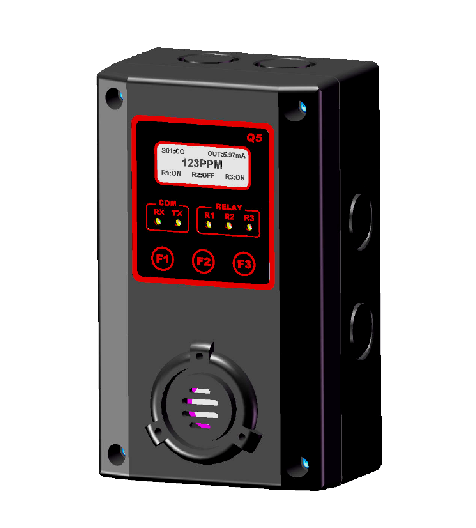
The Q5 platform is a fixed-point gas detection transmitter for mechanical rooms, parking structures, plants and industrial spaces. Rather than building a separate product for every gas, it was designed around smart sensor assemblies — modules that carry their own gas identity, range and calibration data.
That decision is what lets one transmitter cover oxygen, combustible LEL ranges, trace toxic and specialty gases, and infrared CO₂ and SF₆ — 30+ target gases across 44 sensor configurations. The B5 variant adds an embedded BACnet MS/TP stack for direct building-automation integration.
Engineering challenges
Four problems that shaped the design.
1 · Certify to UL 2075
UL 2075 is the listing standard for gas and vapor detectors — a rigorous safety evaluation that relatively few products carry. Compliance had to drive the architecture from the start, not be retrofitted before submission.
2 · One product, dozens of gases
Maintaining separate firmware and hardware per gas would have been unsustainable across 44 sensor configurations. The gas list had to become data, not variants.
3 · Two protocols, one platform
The B5 needed a full BACnet MS/TP stack on a constrained embedded target, sharing hardware and a firmware base with the Modbus/analog Q5.
4 · Calibration at production scale
Every sensor type needs zero and span calibration with a different gas and range. Production and field workflows had to stay repeatable across the whole catalogue.
System architecture
Sensor as a module.
The central architectural choice: the transmitter does not "know" gases. It reads an intelligent sensor assembly that declares what it is, and scales, alarms and reports accordingly.
Smart sensor assembly
A replaceable module carrying the sensing element plus its gas identity, range and calibration data — swappable in the field without changing the transmitter.
Transmitter core
Acquisition, scaling against the declared range, alarm evaluation, relay control and display — driven by sensor metadata rather than firmware variants.
Output layer
4–20 mA analog output and relay outputs for standalone operation and controller integration.
Fieldbus layer
RS-485 carrying Modbus RTU on the Q5, or the embedded BACnet MS/TP stack on the B5.
Electronics
Four sensing technologies on one front end.
Supporting electrochemical cells, catalytic bead elements, NDIR infrared benches and oxygen cells from a common platform meant an analog front end with the range, stability and drive characteristics each technology demands — plus the isolation and protection required for long field cable runs.
Firmware
Embedded C, driven by sensor metadata.
Measurement & scaling
Acquisition and linearisation per sensing technology, scaled against the range declared by the installed sensor assembly.
Alarm & output logic
Setpoint evaluation, latching behaviour, relay control and analog retransmission.
Calibration
Zero and span workflows with stored calibration state and history, consistent across the sensor catalogue.
BACnet MS/TP (B5)
Embedded stack ported and integrated on the B5 variant — object model, services and device management on a constrained target.
Mechanical design
Sealed, mountable, serviceable.
The enclosure had to protect the electronics in plant environments while presenting the sensing element to the monitored air, keeping the sensor assembly replaceable without rewiring, and allowing accessible field terminals — all within the construction constraints that the safety listings impose.
Certification & compliance
The credential that sets this product apart.
UL 2075
Certified as a gas and vapor detector — the specific safety listing for this product class, and a differentiator relatively few competing products carry.
UL 61010
Construction and test requirements for measurement and control equipment, satisfied through the design of the electronics and enclosure.
Certification scope depends on the specific product model, sensor, revision and listing. Marks should only be shown with the exact approved model and listing information.
Detection capability
30+ gases, 44 sensor configurations.
The smart sensor catalogue spans oxygen, combustible LEL ranges, a broad toxic and specialty list including semiconductor gases, and infrared CO₂ and SF₆ — each as an interchangeable assembly.
Gallery
Product.
Development timeline
From requirement to listed product.
Lessons learned
What this product taught.
Make the gas list data, not firmware
Pushing gas identity and range into the sensor assembly meant adding a gas became a catalogue entry rather than a firmware release — the single highest-leverage decision in the platform.
Certification is architecture
UL 2075 requirements influenced construction, isolation and behaviour early. Treating the listing as a design input rather than a final hurdle is what made it achievable.
Two protocols from one base
Sharing hardware and firmware between the Modbus Q5 and BACnet B5 kept the platform maintainable and let a single product family serve both integration markets.
Design the calibration, not just the device
With 44 sensor configurations, a repeatable zero/span workflow mattered as much to production and field service as the measurement circuit itself.
Notes on this case study
Sensor and gas information is based on public QEL / Greystone Q5 product documentation. This page describes documented product capabilities and my own engineering contribution at a high level, rather than confidential design detail. Product names, trademarks, certification marks and commercial specifications belong to their respective owners.
← Back to the product lineup